
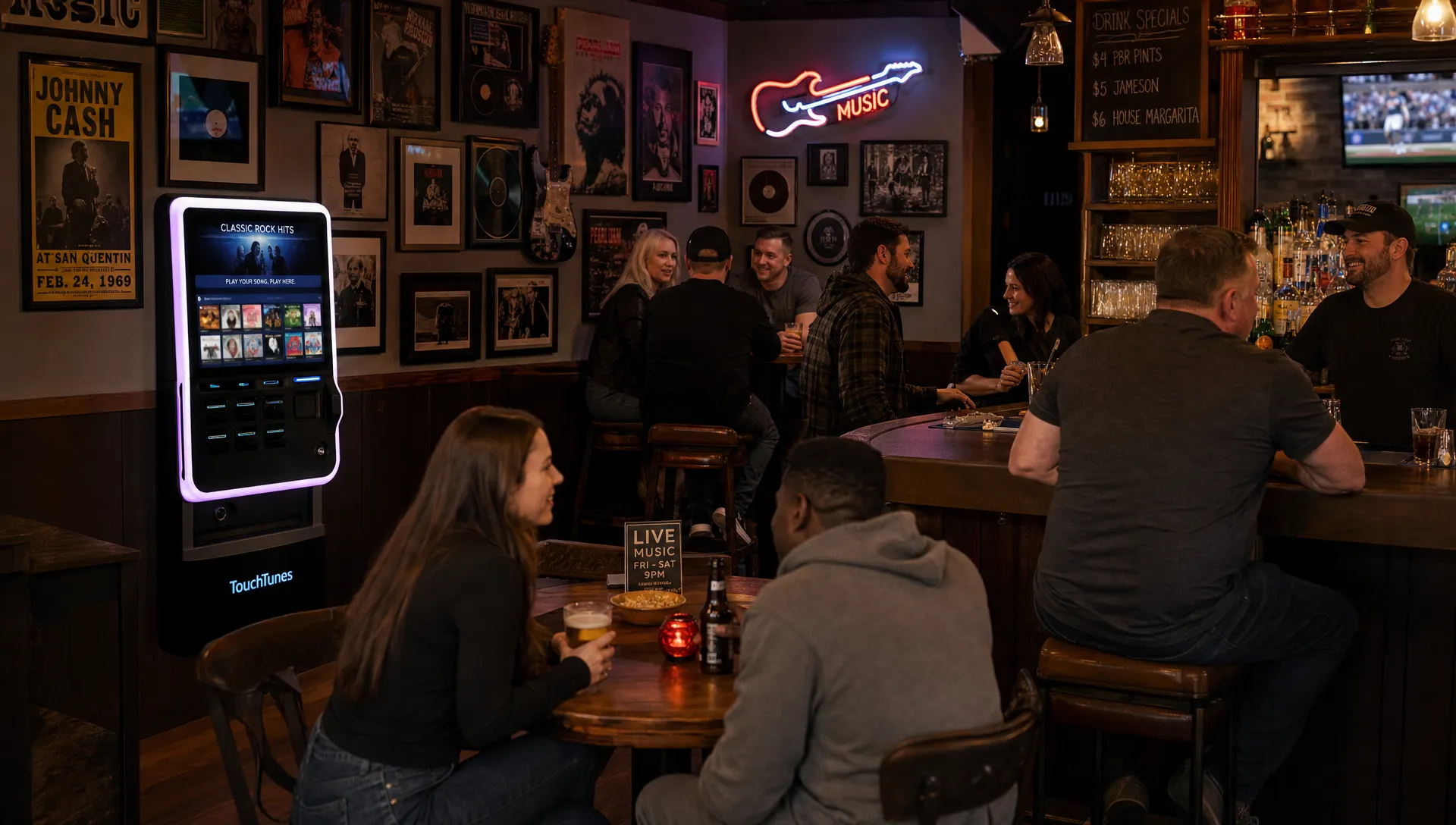
A TouchTunes jukebox does more than play songs. In the right bar, it becomes part of the guest experience, giving customers a reason to stay longer, interact with the room, and come back for the atmosphere they helped create.
For bar owners, that matters. Music is one of the few elements that can change the entire feel of a night within seconds. The wrong playlist can make a room feel flat. The right song, picked by the right guest at the right moment, can turn a quiet table into a singalong, a first round into a second, or an ordinary Tuesday into a night people remember.
Modern jukeboxes are built for that kind of participation. Instead of leaving music entirely to staff phones, consumer playlists, or one person behind the bar, a TouchTunes system gives guests a simple, familiar way to take part while keeping the music experience organized for a commercial venue.
Why a jukebox still matters in a streaming world
Most guests already have unlimited music in their pocket, so it is fair to ask why a bar needs a jukebox at all. The answer is simple: listening alone is not the same as shaping the sound of a public room.
A personal playlist is private. A jukebox is social. When someone pays to hear a song in a bar, they are making a small public statement. They are setting a mood, getting friends involved, reacting to the energy in the room, or trying to win over the crowd with a classic. That interaction is hard to recreate with a passive background playlist.
There is also a business difference. Consumer music apps are not designed to be the entertainment system for a bar. Public music use comes with licensing considerations, and personal streaming accounts are generally not the right solution for a commercial setting. If your venue is currently relying on a phone playlist, it is worth reviewing this music licensing guide for bars before making it your long-term plan.
A commercial digital jukebox gives your venue a more purpose-built option. It supports guest choice, reduces the constant battle over what should play next, and helps create a more polished entertainment experience.
What a TouchTunes jukebox can do for your bar
Turn background music into guest participation
Music is usually treated as atmosphere, but in a bar it can also be an activity. A TouchTunes jukebox invites guests to interact with the venue without needing a tournament, stage, host, or special event.
That matters because participation creates emotional investment. A guest who picks a song is paying attention to the room. A group that takes turns choosing tracks is more engaged than a group sitting silently under a generic playlist. Even guests who do not choose songs often react to the selections, which creates conversation and shared moments.
This is especially useful during slower periods. A jukebox can give early-evening customers something to do before the room fills up, and it can help late-night guests keep the energy going without requiring staff to constantly manage the soundtrack.
Give customers control without giving up control
One concern many bar owners have is that guest-selected music could become chaotic. In practice, a professionally installed digital jukebox is designed to give patrons choice while keeping the experience appropriate for the venue.
The goal is not to let the loudest customer take over the bar. The goal is to create a guided music environment where guests can make selections within a system built for public entertainment. Depending on the setup, venue needs, and operator configuration, a commercial jukebox can help support a more manageable music experience than handing over an aux cord or letting multiple staff members rotate personal playlists.
That balance is important. Your regulars may want rock, country, hip-hop, dance, Latin, throwbacks, or pop depending on the night. Your staff may want the room to stay consistent. A jukebox lets the crowd influence the vibe while the venue still maintains a professional entertainment setup.
Create an additional revenue opportunity
A TouchTunes jukebox can also contribute directly to the business side of your bar. Guests pay for credits to play songs, and that can create an entertainment revenue stream for the venue, depending on the placement agreement and operator arrangement.
The bigger value, however, is not only the money from song plays. It is what the right music can do for dwell time and repeat visits. When guests feel comfortable, entertained, and connected to the room, they are more likely to order another drink, stay through another game, wait for friends, or choose your bar the next time they go out.
A jukebox will not fix weak service or a poor layout, but it can support a stronger guest experience. For many bars, that is where the real return is found.
Support phone-first customers
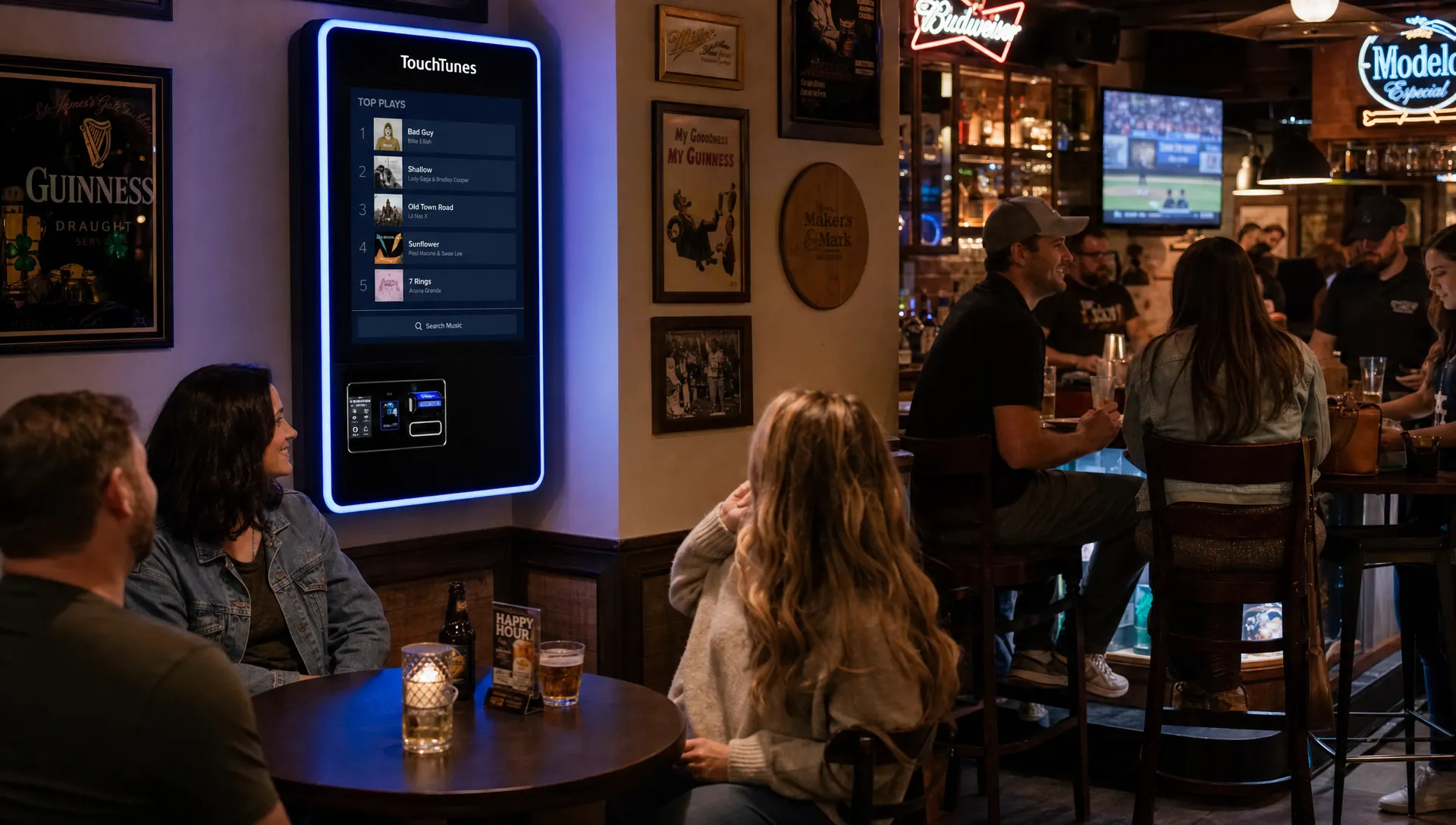
Today’s guests expect to interact with venues through their phones. TouchTunes fits naturally into that behavior. Customers can use the mobile experience to search for music, choose songs, and engage with the jukebox without crowding around the machine.
That convenience makes a difference in busy bars. A guest can stay with their group, browse songs from a table, and add to the night’s soundtrack. McGee Amusements has also covered how the TouchTunes mobile app helps make digital jukebox use easier and more familiar for modern customers.
The result is a music experience that feels current. The physical jukebox still anchors the room, but guests can participate in a way that matches how they already behave.
TouchTunes vs. a regular playlist
A playlist can be useful for simple background music, but it is not the same as an interactive bar entertainment system. Here is how the two experiences differ from a venue owner’s point of view.
| Feature | Regular playlist | TouchTunes jukebox |
|---|---|---|
| Guest participation | Limited or none | Guests can choose songs and shape the mood |
| Staff involvement | Staff often manage music manually | Music selection can be handled through the jukebox experience |
| Revenue potential | No direct song-selection revenue | Paid song credits may create a revenue opportunity |
| Commercial fit | Consumer apps may create licensing concerns | Built for public venue entertainment use |
| Atmosphere | Controlled by one playlist or staff member | More dynamic and crowd-responsive |
| Customer experience | Passive background sound | Interactive entertainment customers remember |
The key difference is engagement. A playlist fills silence. A jukebox gives guests something to do with the music.
How bars can use a TouchTunes jukebox to build better nights
A jukebox works best when it is treated as part of your venue strategy, not just a machine on the wall. The right placement, promotion, and staff awareness can help it become a natural part of the room.
Start by making it visible. Guests are more likely to use a jukebox when they see it early in the visit, especially near high-traffic areas where it does not block movement. If your bar has separate zones, such as a main bar, dining area, pool table, or game section, placement should support the area where guests are most likely to socialize.
Then connect the jukebox to the rhythm of your week. A neighborhood bar might use it to support regulars on weeknights. A sports bar might let guests keep the energy going before and after games. A restaurant with a late-night crowd might use it as a bridge between dinner service and bar service.
Simple ideas can help guests engage:
- Promote a throwback night where guests pick favorites from a specific decade.
- Encourage regulars to start the first round of songs during happy hour.
- Pair jukebox activity with pool, darts, arcade games, or basketball games.
- Use music to support slower nights when you do not have live entertainment.
- Let the crowd build momentum before a game, holiday weekend, or special event.
These ideas do not require complicated programming. The point is to remind guests that your bar is not just a place where music happens in the background. It is a place where they can be part of the soundtrack.
Why installation and support matter
The best jukebox experience depends on more than the equipment itself. Bars need commercial-grade installation, reliable setup, and responsive support from a company that understands the environment.
A jukebox in a bar has to deal with noise, crowds, limited space, long operating hours, and changing customer behavior. It should be placed well, connected properly, and supported by someone who can help when questions come up. That is very different from putting a speaker in the corner and hoping a playlist works all night.
For bars in New York and New Jersey, McGee Amusements supplies and installs venue entertainment equipment, including TouchTunes digital jukeboxes, arcade-style games, photo booths, ATMs, and related support services. If you are comparing options, the TouchTunes Virtuo jukebox installation page is a useful place to see how a modern digital jukebox can fit a bar or restaurant setting.
Is a TouchTunes jukebox right for every bar?
A TouchTunes jukebox is especially useful for venues where music is part of the social experience. That includes neighborhood bars, taverns, sports bars, casual restaurants, lounges, and locations with games or late-night traffic.
It may be less central in a venue where music must remain tightly curated at all times, such as a fine dining room with a very specific brand sound. Even then, a separate bar area may benefit from interactive music if the layout and guest expectations support it.
The best way to decide is to look at how guests already behave. Do they ask bartenders to change the music? Do regulars talk about songs? Do people gather around games, pool tables, or the bar after dinner? Do you have slower nights that need a low-maintenance entertainment boost? If the answer is yes, a jukebox could be a smart addition.
Frequently Asked Questions
Does a TouchTunes jukebox replace live music or a DJ? Not necessarily. It fills a different role. A jukebox provides everyday interactive entertainment, while DJs and live acts are usually scheduled events. Many bars use a jukebox to keep music engaging on nights when there is no live entertainment.
Can a TouchTunes jukebox help my bar make money? It can create a revenue opportunity through paid song selections, depending on your agreement and setup. It can also support indirect revenue by improving the guest experience and encouraging customers to stay longer.
Do guests have to use the physical jukebox? No. Many guests interact through the mobile experience, which makes it easier to browse and play songs without leaving their table or group.
Is a jukebox better than using Spotify in a bar? A jukebox is built for public venue entertainment and guest interaction. Consumer streaming accounts are generally designed for personal use, so bars should understand licensing and commercial-use requirements before relying on them.
What types of bars benefit most from TouchTunes? Bars with social crowds, regular customers, games, sports viewing, happy hours, or late-night traffic are often strong fits because music choice becomes part of the overall experience.
Bring a better music experience to your bar
A TouchTunes jukebox can make your bar more interactive, more memorable, and easier to manage from an entertainment standpoint. It gives guests a role in the night while helping your venue move beyond passive background music.
McGee Amusements supplies and installs TouchTunes jukeboxes and other entertainment equipment for bars and restaurants in New York and New Jersey. If you want to explore the right jukebox setup for your space, visit McGee Amusements to get started.